
My Child Was Diagnosed with a Rare Genetic Disease. What Are the Steps to Develop a Treatment?
If your child was just diagnosed with a rare genetic disease, you probably heard some version of "there's no treatment" or "there's nothing we can do."
Here is what they should have told you: there is no approved treatment. That is a very different statement.
There are approximately 10,000 recognized rare diseases. Fewer than 5% have a specific pharmacological therapy. But "nothing on the label" does not mean nothing is possible.
In 2018, a team at Boston Children's Hospital, led by Dr. Timothy Yu, developed milasen, the first antisense oligonucleotide (ASO) designed for a single patient. The patient, a six-year-old girl named Mila with CLN7 Batten disease, had a mutation so rare that no drug company would ever develop a treatment for it. The team identified her mutation through whole genome sequencing, designed a custom ASO to correct the resulting splicing error, tested it in her cells, manufactured it to clinical grade, and filed with the FDA. The entire process, from mutation identification to first dose, took less than 12 months. Her seizures decreased significantly.
Since then, the field has grown. The n-Lorem Foundation has built a pipeline of over 90 target genes and filed more than a dozen INDs with the FDA, developing individualized ASO therapies for patients with nano-rare diseases. Atipeksen, a custom ASO for ataxia-telangiectasia, has kept a patient stable for over three years in a disease that normally progresses every year. And in January 2025, the IRDiRC (International Rare Diseases Research Consortium) published a formal roadmap for N-of-1 therapy development in Nature Reviews Drug Discovery, establishing ASOs as the most mature modality for individualized treatments.
On February 23, 2026, the FDA formalized the regulatory pathway, publishing a framework that allows therapies designed for individual patients to receive full, permanent approval.
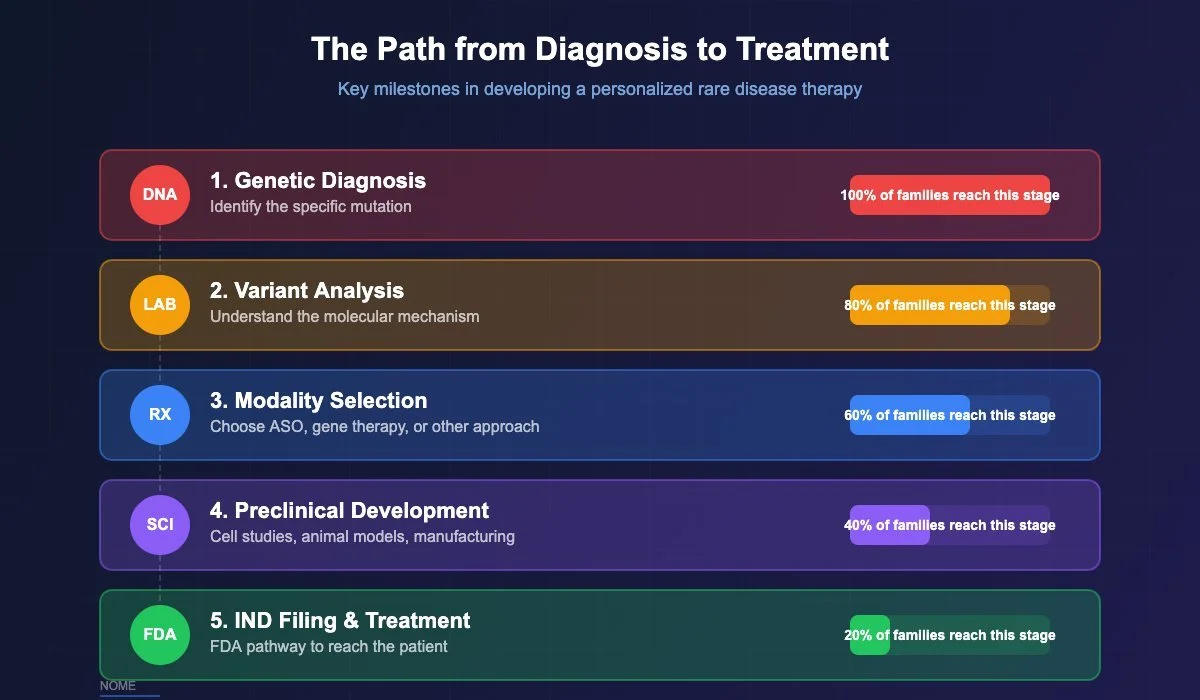
What follows is the process. Step by step, from diagnosis to treatment. It is aligned with the IRDiRC N-of-1 development roadmap and reflects how programs are actually executed today.
Phase 1: Identifying Whether Your Child Is Eligible
The IRDiRC roadmap begins with three questions: Can you identify the genetic cause? Is the disease treatable with an existing modality? And does the patient have a realistic chance of benefiting?
Step 1: Get a definitive molecular diagnosis
Everything starts here. You cannot design a therapy if you don't know the exact gene and the exact DNA change causing your child's disease.
A clinical diagnosis ("your child has X syndrome based on symptoms") is not enough. You need the molecular diagnosis: the specific gene, the specific variant, confirmed by sequencing.
Whole genome sequencing (WGS) is the gold standard. It reads all 3 billion base pairs, catches deep intronic variants and structural changes that gene panels miss, and costs under $500 for sequencing alone (though total clinical testing costs vary depending on the condition and provider). The diagnostic yield for rare disease is 40-60%, depending on the condition and the cohort studied.
If your child has already had WGS and it was negative or inconclusive, ask for reanalysis. Databases update constantly. Variants classified as "uncertain significance" a few years ago may now be classifiable.
Where to go: GeneDx, Invitae, or Baylor Genetics for clinical sequencing. The NIH Undiagnosed Diseases Program (UDP) or Undiagnosed Diseases Network (UDN) for complex cases.
Step 2: Understand what your mutation does
It is not enough to know the name of the gene. You need to understand what the mutation does at the molecular level, because that determines whether an ASO can address it and how it would work.
Splicing defect: The mutation causes the cell to misread the gene's instructions during RNA processing. An ASO can bind to the RNA and force the cell to read it correctly. This is the mechanism behind both Spinraza (for SMA) and milasen (for CLN7 Batten disease). Splicing defects are the fastest path to a custom ASO.
Gain-of-function: The mutation causes the gene to make a toxic protein that actively damages cells. An ASO can bind to the RNA message and flag it for destruction, preventing the toxic protein from being made. This is how tofersen (Qalsody) works for SOD1-ALS.
Reading frame break: The mutation breaks the reading frame of the gene. An ASO can tell the cell to skip the broken section entirely. The resulting protein is shorter than normal but may still be functional. This is the approach used in exon-skipping ASOs for Duchenne muscular dystrophy.
Loss-of-function (large gene): The mutation eliminates the protein entirely in a gene too large for gene therapy. ASO approaches may still apply if there is a backup gene or alternative splicing strategy. If not, gene therapy or gene editing may be more appropriate, though those programs typically take longer and cost more because ASOs are simpler to manufacture in small lots.
A genetic counselor or clinical geneticist can interpret your sequencing results and explain the functional consequence. Nome also characterizes this as part of our free evaluation.
Step 3: Assess whether a personalized therapy could realistically help
Not every patient is a candidate. The IRDiRC roadmap emphasizes that eligibility depends on multiple factors beyond the gene itself: which organs are affected, whether ASOs can be delivered to the relevant tissue, and whether the patient is still within a treatment window where intervention can make a difference.
The question of treatment window matters too. If a disease has already caused irreversible structural damage, restoring the missing protein may not reverse that damage. But for progressive diseases where the patient still has residual function, stabilization or slowing of progression can be profoundly meaningful.
Submit your child's genetic diagnosis to Nome for a free evaluation. Within 1-2 weeks, you will receive an expert-reviewed analysis of whether a personalized therapy is feasible for your child's specific mutation.
Phase 2: Developing the Therapy
Once eligibility is established, the IRDiRC roadmap moves into therapy development and preclinical evaluation.
Step 4: Develop a patient-specific cell line
Before any therapy can be tested, you need a biological model that carries your child's specific mutation. This typically starts with a simple skin biopsy (a small punch, performed in a clinic) or a blood draw. The collected cells are reprogrammed in a lab into induced pluripotent stem cells (iPSCs), which can then be differentiated into the relevant cell type for your child's disease.
For a retinal disease, iPSCs can be turned into photoreceptor precursor cells or retinal organoids (miniature retinas grown in a dish). For a neurological disease, they can become neurons. For a liver disease, hepatocytes. These patient-derived cells give researchers a model system carrying your child's exact mutation.
For some conditions, an animal model may also be relevant. Zebrafish models are faster to generate than mouse models and can provide functional readouts. Mouse models carrying the patient's mutation can provide more detailed pharmacological and safety data.
For reference: in Nome's Blueprint for a USH2A Usher syndrome patient, we recommended initiating retinal organoid development at the start of the program and running it in parallel with ASO design and screening, because the organoid would be needed downstream for efficacy testing but takes the longest to produce.
Step 5: Establish natural history baseline
Natural history data records how your child's disease progresses without treatment. It becomes the comparison point for any future therapy.
The intensity of natural history documentation varies by how rare the condition is. For diseases with existing published natural history studies and larger patient populations, the baseline may already be well characterized. For nano-rare conditions (fewer than 30 patients worldwide, per n-Lorem's definition), where little or no published data exists, your child's individual baseline data becomes the primary comparator.
Start collecting this data as soon as you have a diagnosis, even before a therapy is in development. Under the FDA's February 2026 individualized therapy framework, natural history data serves as the control arm for clinical evaluation. The data you collect now becomes the evidence that a future therapy is working.
Step 6: Design and screen ASO candidates
With the mutation characterized and a cell line in development, the ASO itself can be designed.
This means designing 10-30 candidate ASO sequences, each targeting a different region of the RNA. These candidates are screened in cells (initially in generic cell lines relevant to the tissue, and later in the patient's own iPSC-derived cells) to identify which candidates most effectively correct the molecular defect. The goal is to narrow down to 1-3 lead candidates that show the strongest target engagement and dose-response.
The milasen program at Boston Children's followed this exact process. The team designed ASOs targeting the aberrant splicing event, screened them in patient-derived fibroblasts, confirmed splice correction, and selected the lead candidate based on efficacy and tolerability data.
Step 7: Efficacy testing
Once lead candidates are identified, they are tested more rigorously. This means demonstrating splice correction, protein restoration, or whatever the intended molecular effect is, in patient-specific cells. Ideally this includes dose-response data: more drug produces more effect.
The IRDiRC roadmap notes that preclinical development for individualized treatments is particularly time-sensitive when dealing with progressive diseases. A balance must be struck between establishing that the therapy is likely to be effective and ensuring that treatment can be initiated while the patient is still within a treatment window.
Step 8: Safety testing
For ASOs, the 11 FDA-approved ASO drugs provide a substantial body of class safety data. The February 2026 FDA framework explicitly allows individualized ASO programs to reference this platform data, reducing the need for de novo safety studies for each new sequence.
As the IRDiRC roadmap describes it, individualized treatments build on data available for approved treatments of the same modality. The individualized treatment is not identical, and preclinical safety studies for the specific ASO sequence remain important.
Step 9: GMP manufacturing
The ASO must be manufactured to clinical grade (GMP, Good Manufacturing Practice). GMP oligonucleotide synthesis is a well-established process. Manufacturing a patient-specific ASO batch typically takes 8-20 weeks.
Booking manufacturing capacity early in the program, before the lead candidate is finalized, can save months. The milasen program and n-Lorem's pipeline both demonstrate that manufacturing is a solved problem for ASOs. The challenge is coordination and timing, not technology.
Phase 3: Treatment and Evaluation
Step 10: FDA filing and first dose
Under the FDA's individualized therapy framework, the pathway is IND (Investigational New Drug application) followed by NDA (New Drug Application). The IND includes the manufacturing data, safety data, and clinical protocol. Once the IND is active and IRB approval is obtained, treatment can begin.
The clinical evaluation is a single-patient study, with outcomes compared to the patient's own natural history baseline or published natural history data for the condition.
If the therapy demonstrates clinical benefit, the sponsor can file for full, permanent FDA approval. This enables insurance reimbursement, eliminates annual re-authorization, and creates precedent for future patients.
Putting It All Together
The full process for an ASO program, from genetic diagnosis to first dose, typically takes 9-18 months for straightforward splicing defects. Programs involving less-characterized mutations, novel biology, or complex organoid development can take longer.
Many steps can and should run in parallel. Cell line development alongside ASO design. Natural history data collection alongside preclinical testing. Manufacturing slot booking alongside safety studies. The difference between a longer program and a shorter one is often as much about coordination as it is about the science itself.
What Nome Does
Nome provides free genetic analysis for any rare disease family. We evaluate your child's mutation, characterize what it does at the molecular level, determine whether an ASO or other modality is viable, and generate a development plan, what we call a Blueprint, with recommended steps, partners, timelines, and milestones.
Our Blueprints are how we have supported families like one with a USH2A mutation causing Usher syndrome, where we evaluated the feasibility of ASO therapy, sourced and scored 14 specialized vendors through a competitive RFP process, and delivered two development pathways with detailed cost and timeline comparisons. That evaluation, partner selection, and program design is what Nome does.
The first step is always the same: get a genetic diagnosis, then find out what is possible.
Submit your diagnosis for a free evaluation at nome.bio.
REFERENCES
1. Jonker AH, et al. Nature Reviews Drug Discovery. 2025;24:40-56.
2. Kim J, et al. NEJM. 2019;381:1644-1652.
3. FDA. Framework for Individualized ASO Drug Products. February 2026.
4. Nguengang Wakap S, et al. Orphanet J Rare Dis. 2020;15(1):18.
5. Crooke ST. Nat Biotechnol. 2021;39:671-677.
6. Kim J, et al. Nature. 2023.
This article is for informational purposes only and does not constitute medical advice.